Board Game Mechanisms I Love

When you start playing board games, you quickly learn which type of games speak to you, and finding your “perfect fit games” is so rewarding.

Here are my ten favorite board game mechanisms, keeping in mind that many games have an overlap of several mechanics.

Engine-building

Engine builders are games in which each turn (should) build on previous turns, strengthening the cards in your play area and having them work off one another to earn more points as the game goes on. Engine-builders require a great deal of thought and planning for maximum points, making them incredibly fun and satisfying when you craft a powerful engine.

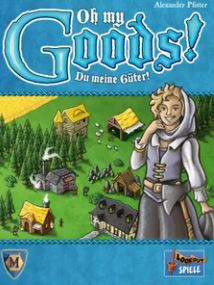
On our Shelf: San Juan, Oh My Goods!, Everdell

I can’t wait to play: Imperial Settlers, Wingspan, Century Golem Edition


Worker placement
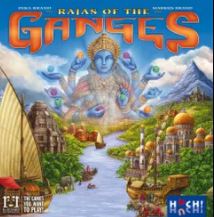

Players select actions, usually represented by locations on a game board, and send out their “workers” to complete a task. Generally, once a player has taken a spot, this spot is no longer available to other players’ workers. Each worker’s tasks are important to game goals.

On Our Shelf: Rajas of the Ganges, Viticulture

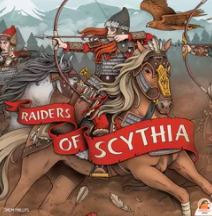
I can’t wait to play: The Pursuit of Happiness, Raiders of Scythia


Tableau building


In tableau games, players are using cards to play into their individual player areas, usually using cards that work together to create a sort of scene and complete goals to earn points.

On Our Shelf: Santa Monica, Everdell


Tile laying/placement


In tile-laying games, players draft tiles to lay in the play area to score points or trigger events in the game.

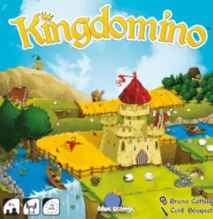
On our Shelf: Cacao, Kingdomino


Drafting


Drafting is a mechanism of selecting and then passing cards or other game components to players as a means of completing tasks or scoring points (“pick and pass”). Sometimes the cards and components remain hidden as they are passed, and sometimes the cards or components are laid out for all to see and choose from.

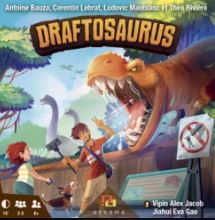
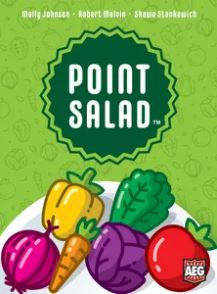
On Our Shelf: Sushi Go, Draftosaurus, Fantasy Realms, 7 Wonders Duel, Point Salad


Deck / Bag / Pool Building


In deckbuilding games, players start with their own small deck of cards, playing them on their turns to acquire new cards and grow their deck in size and strength.

On our Shelf: Star Realms, Friday, Orleans

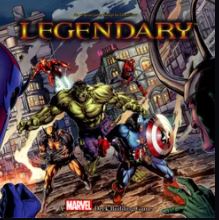
I can’t wait to play: Clank!, Marvel Legendary


Contracts
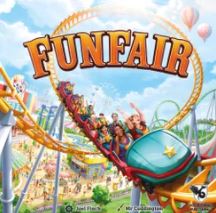

Contracts in games are goals that players must fulfill to earn points or other rewards. These goals, or contracts, can either be private or public goals that all players can view and attempt to complete.

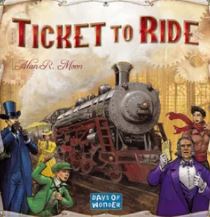
On our Shelf: Funfair, Welcome to Your Perfect Neighborhood, Ticket to Ride


Dice rolling


Anyone that has played a board game is familiar with dice rolling, most likely a mechanic used to move in standard mass market games. (Yawn.) I love dice, and I love games that have dice with ways to mitigate the rolls.

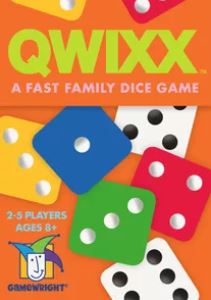
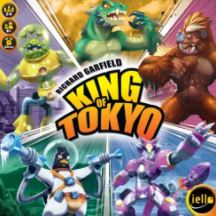
On our Shelf: Pioneer Days, Quixx, King of Tokyo

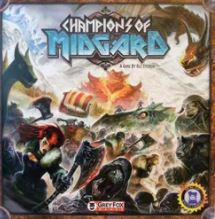
I can’t wait to play: Champions of Midgard


Push-your-luck


In push-your-luck games, players do exactly that…taking a next turn and possibly losing all progress or continuing on and edging out the opponents. It’s the standard dilemma of risk versus reward, board game style, and so much fun.

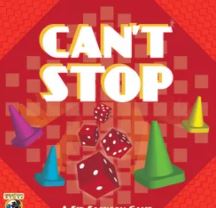
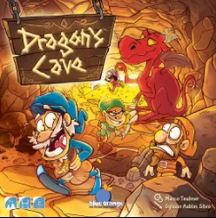
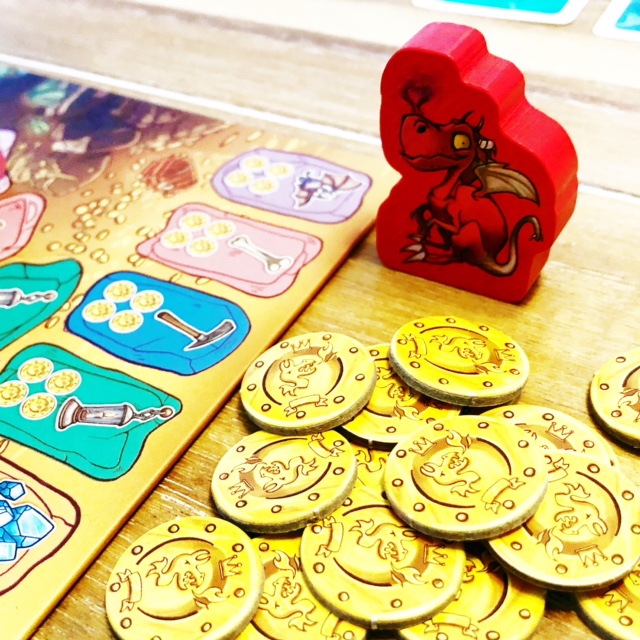
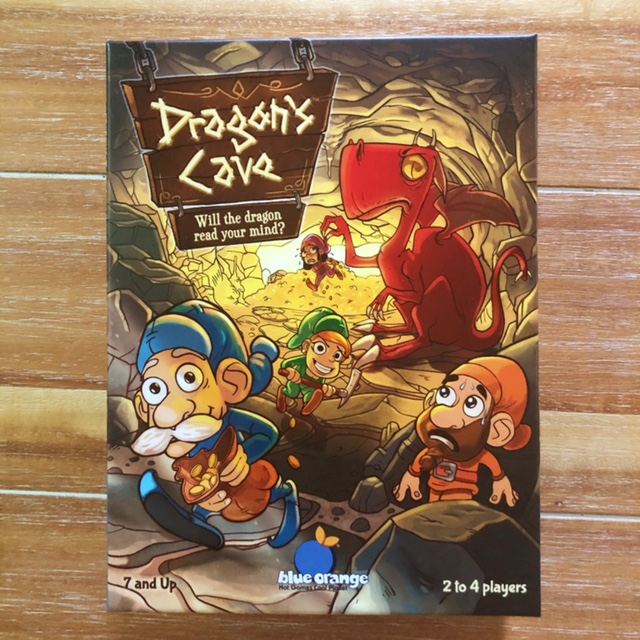
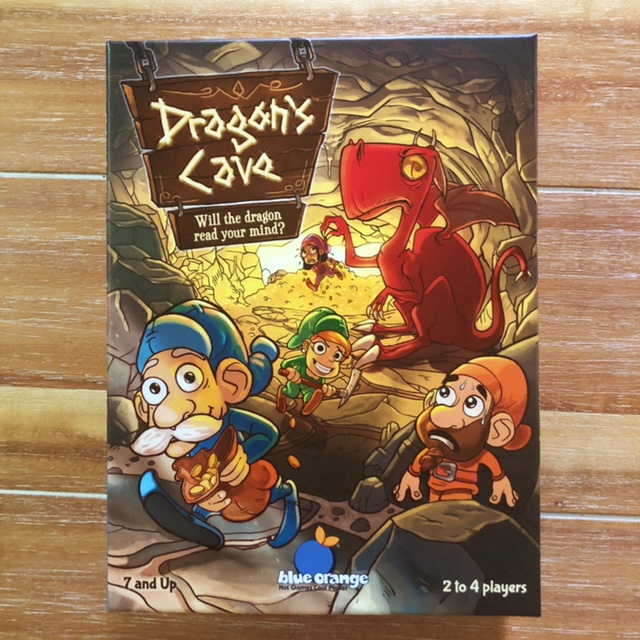
On our Shelf: Push, Dragon’s Cave, Can’t Stop (I play this one on Board Game Arena.)


Set collection

The value of items is determined by collecting a set, usually in card games.

Board games often have several mechanics in action, and our favorite games use our favorite mechanics. (Makes sense, right?)


What is your favorite game mechanic? Join the group on Instagram for #mechanismsmonday to post your game photos based on the week’s theme!
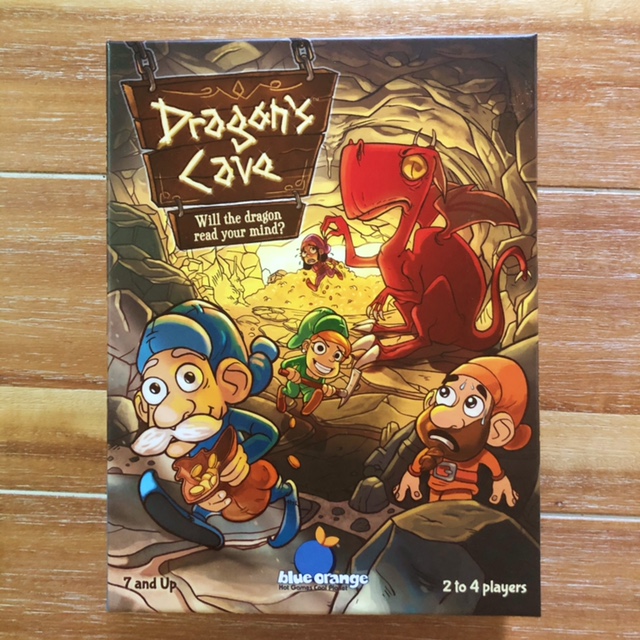
(Review) Dragon’s Cave


Dragon’s Cave is a fun, quick game that usually results in a lot of laughter around the table.

Here’s what we think about Dragon’s Cave, in our own words:

Stephanie: I am always up for a game of Dragon’s Cave. I enjoy push-your-luck games, and the suspense with this one is just enough for kids and families. We really get into the hiding of the gold in our hands – it is extremely dramatic. I feel like we rarely beat Brian, but, whatever.

Brian: I liked this game more with the first few plays, but it’s a great first game to introduce kids to the concept of probability. There are other children’s games I would rather play as a family, so this one isn’t a favorite of mine.

5 year-old: I like to play the game. I like the coins. I like the cards. I also like the little dwarves.


Who should play: families who want a quick game that is easy to learn and fun for all ages


Good for newbies? 
For sure – it’s an accessible family/children’s game.

Good for kids? Blue orange designs many fun family games. Dragon’s Cave works well for children as young as 4-5 years old.

Want to learn more about Dragon’s Cave? Check out this post that covers the game in-depth!

Dragon’s Cave

A shout-out to the awesome Andrew and Anitra over at The Family Gamers podcast, who sent us a copy of this game. Thank you!

Sneak through the dragon’s cave collecting gold…but look out! If the dragon guesses your next move, you’ll need to go back on the path and risk losing your gold!

Further reading: our family’s review

Dragon’s Cave

Designer: Marco Teubner

Publisher: blue orange

2-4 players

approx 20 minutes

Theme: dragons / treasure

Mechanisms: action retrieval, push your luck


Overview

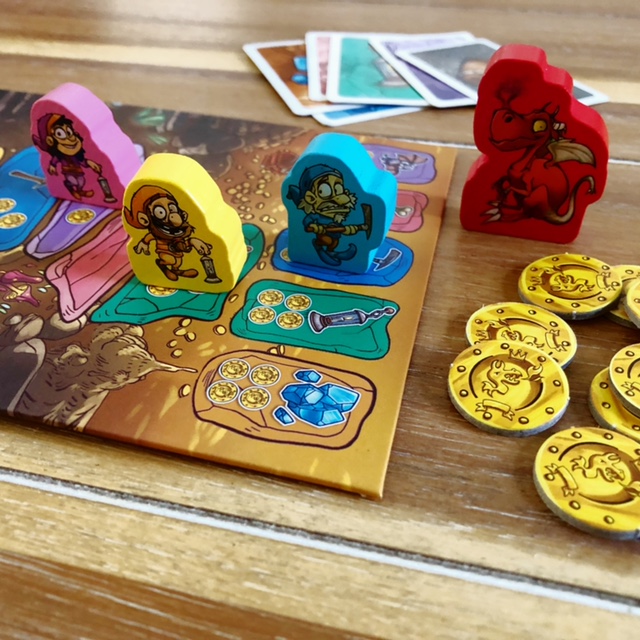
Players take on the role of brave little dwarves who, lured by the promise of gold, enter the dragon’s cave to explore its riches. The dragon, played by an alternating player each round, tries to guess which colored area the dwarves will advance to, hoping to guess correctly, collect their gold, and send them back on the path.

Components

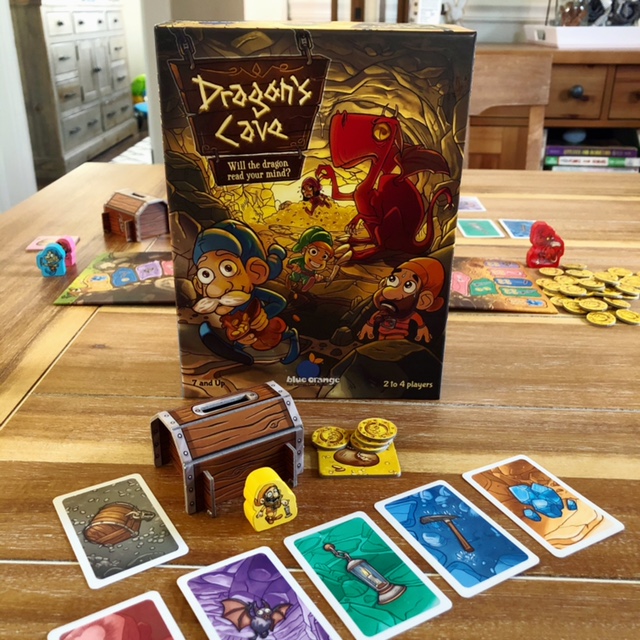
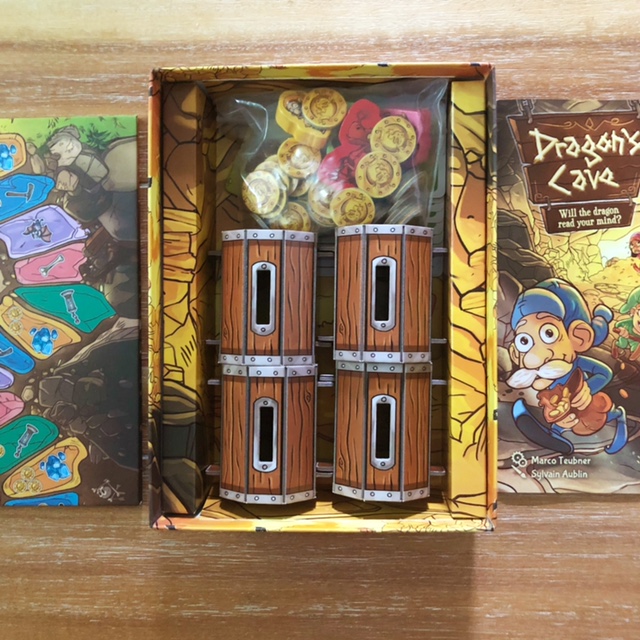
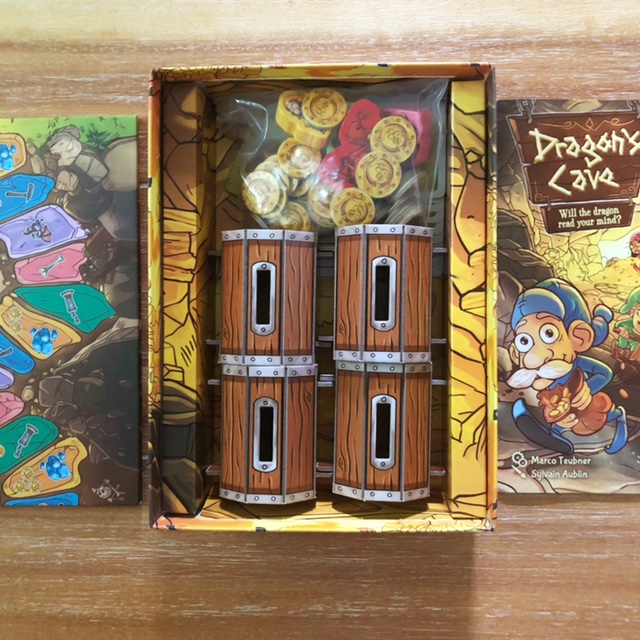
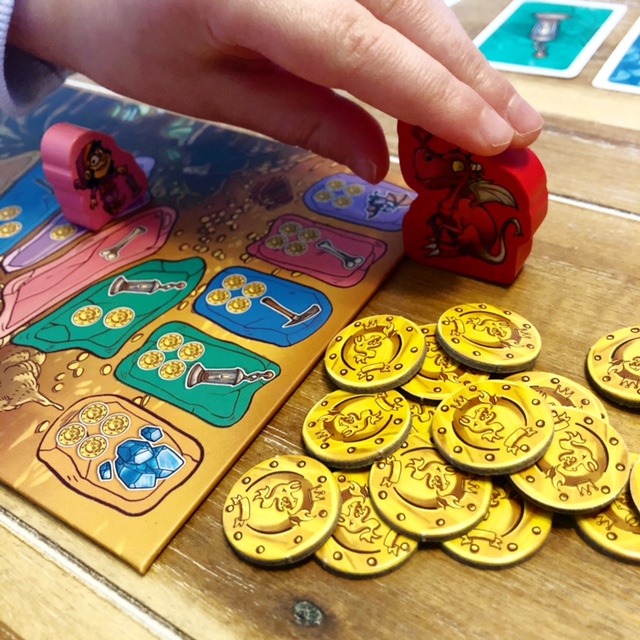
The components of the game are simple, but well-made and fit perfectly inside the box. The dwarves and dragon are nice chunky wood, and the treasure chests and gold coins are heavy cardboard. The cards are of good quality.

Rule Book

Easy to read – no issues.

How the Game Plays

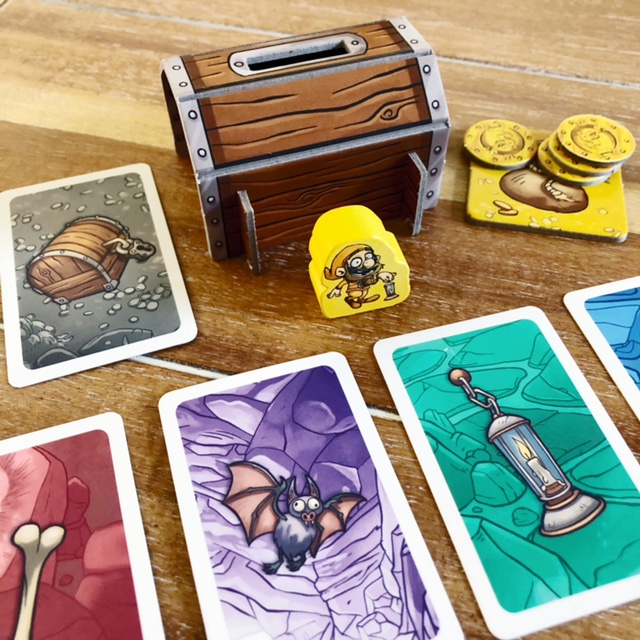
Each player receives a colored dwarf, a coordinating set of colored cards representing the spaces on the cave’s path, a treasure chest, and a treasure square.

The youngest player will play the first round as the dragon, and then this role will move clockwise around the table. The other players will be dwarves.

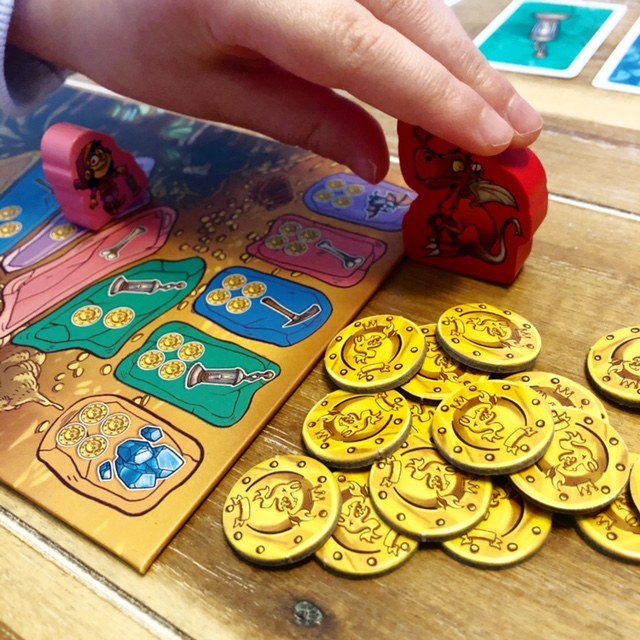
Decide which colored area you would like to move your dwarf to, laying the corresponding card face-down on the table. Once all players have selected and laid out their cards, the dragon chooses a colored space at the top of the board.

If the dragon chooses your color: you must take any treasure NOT inside your treasure chest, secretly place it in one hand or divide between both hands, and allow the dragon to choose a hand. You must then move back to the previous square of the same color.

If the dragon does not choose your color: you advance your dwarf and take any gold earned, placing it on your treasure square – NOT in the treasure chest.

Any cards played remain in front of each player until the player “resets” their hand by playing the grey treasure chest card and moving the gold coins from the treasure square to the treasure chest, which protects the coins from the dragon. The cards then go back into the player’s hand.

Play continues, rotating roles, until a dwarf reaches the end of the path and takes the bonus coins. Count up all coins in your treasure chest and on your treasure square – the player with the most coins wins.

Who Should Play?

This is a fun children’s/family game that could play well with children as young as 4-5 years old. It’s relatively quick and has silly moments, sure to make for lots of laughs. Children could become frustrated if the dragon keeps guessing the color they choose, preventing them from advancing through the cave.

Math Games for Preschool/Kindergarten

Here are some of our family’s current favorite games for practicing math skills with our daughter:

Push

Sort cards into a maximum of three piles without duplicating color or number, trying to bank the most points. Push your luck, and you might bust and miss out on taking a card stack and then have to roll the dice to discard! We sort cards into piles of ten to practice addition and counting by tens during end game scoring.

Roll for it!

Roll your dice to match the dice required by each card to earn the card for scoring, but watch out, because other players might want the card too! The first player to collect enough cards to reach 40 points wins. We use this game for dice and pattern matching, and addition.

Dragonwood

Collect adventurer cards in sets of matching colors, numbers, or in sequential order to earn dice to roll for capturing creatures in the forest. The six dice are numbered from 1-4, so practicing addition is fantastic in this game. Probability also factors in – how many dice do you need to try to roll a particular number? Our daughter sometimes needs help with this skill.

Check the Oven!

Collect various baked goods to equal a dozen each by requesting from players what you would like. (Go-Fish-style.) The game also involves bluffing, as all players must lay down cards on each turn. Get rid of the pie cards, because they cost points at the end of the game. This is a good game to introduce basic addition to 12 points. Melon Rind games has additional titles in this series for more complex math skills too!

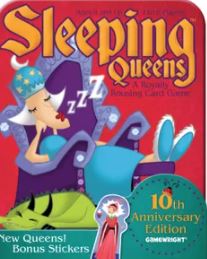
Sleeping Queens

This was our daughter’s first card game, and it is still a favorite. Discard number cards or sets of matching number cards to draw from the draw pile, hoping to find king cards to wake the sleeping queens. Each queen has a point value – the first player to 5 queens or 50 points wins. Watch out for knights and sleeping potion! This is a perfect game to introduce number recognition and number matching to little gamers.

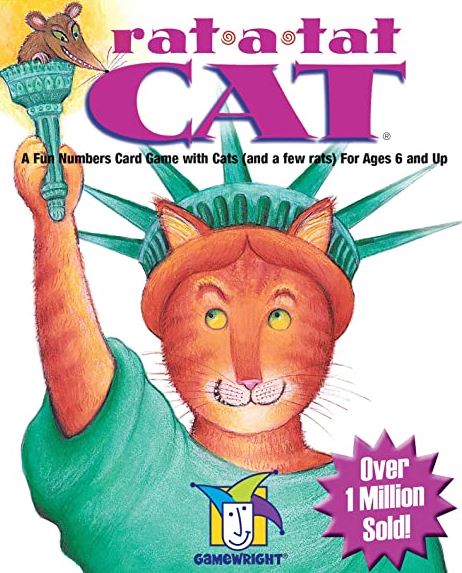
rat-a-tat Cat

Deal four cards facedown to each player, only peeking at the two cards on the ends. Draw a card each turn, hoping to replace the higher value cards with lower value cards, aiming for the lowest score. When you’re ready to score, call out “rat-a-tat-cat!” and each player takes their final turn. Memory and basic addition of cards numbered 1-9 are practiced with this game. It’s one of our family’s favorites, and we play five rounds per game then score.

I am an Amazon affiliate and earn commission when you purchase through the links included on my website. Thank you for your support!

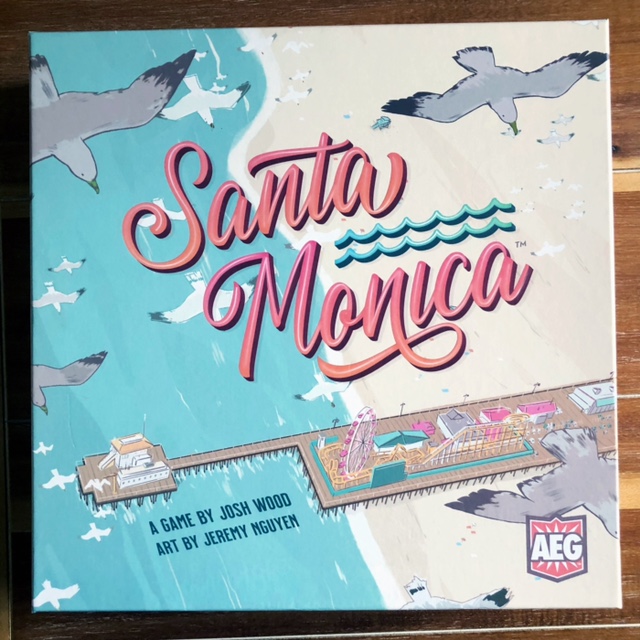
Santa Monica

Design a Santa Monica neighborhood that appeals to tourists, locals, and VIPs to score the most points.

Santa Monica

Designer: Josh Wood
Publisher: AEG

2-4 players

25-45 minutes

Theme: city building / travel

Complexity according to Board Game Geek: 2.17/5

Mechanisms: card drafting, tableau building, chaining, set collection


Overview

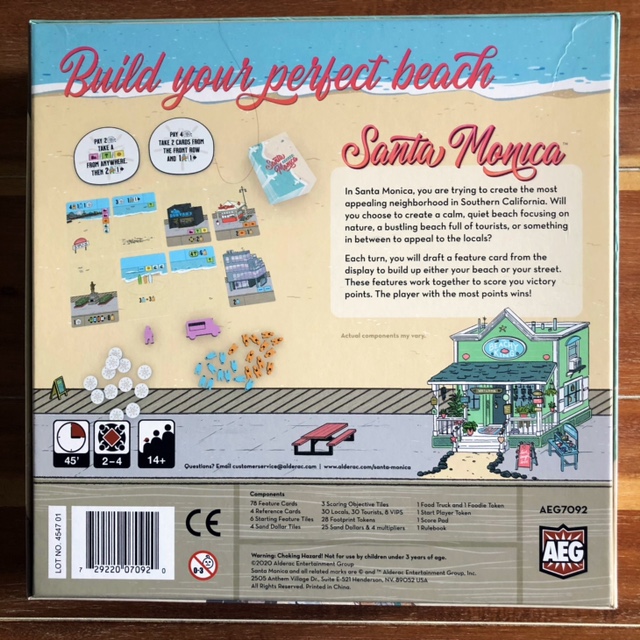
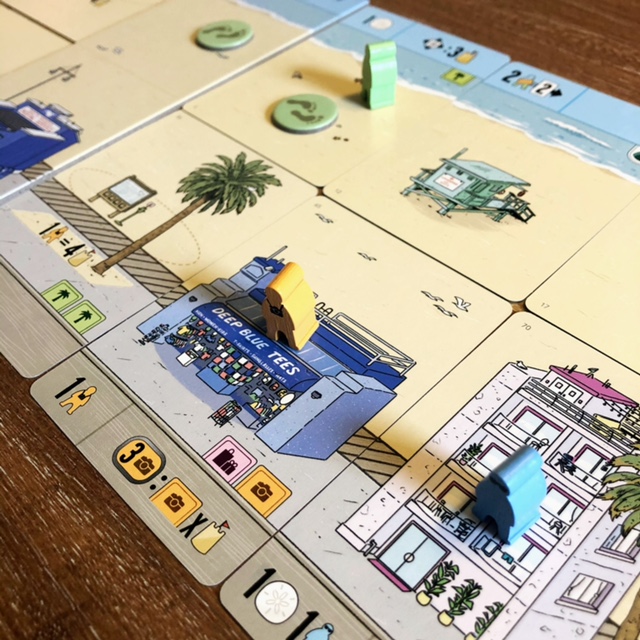
Draft cards or spend sand dollar currency to build a Santa Monica beach neighborhood that pleases tourists, locals, and VIPs while trying to meet various scoring conditions on the cards. You might focus on the beach by linking waves or leading locals to play volleyball. Or maybe you’ll build shops and restaurants along your street for the VIPs to visit. Why not a little of both? Either way, you can only play 14 cards into your neighborhood tableau.

Components

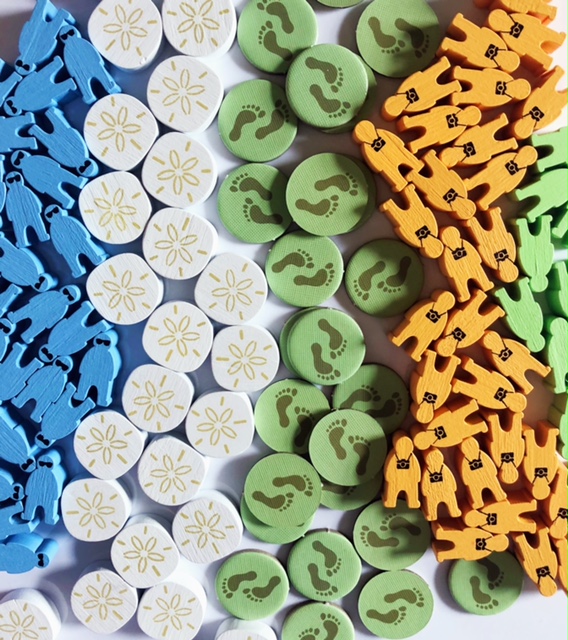
Check out the dreamy pastel shades of the meeples/components:

Light blue locals

Sand dollars (used as currency)

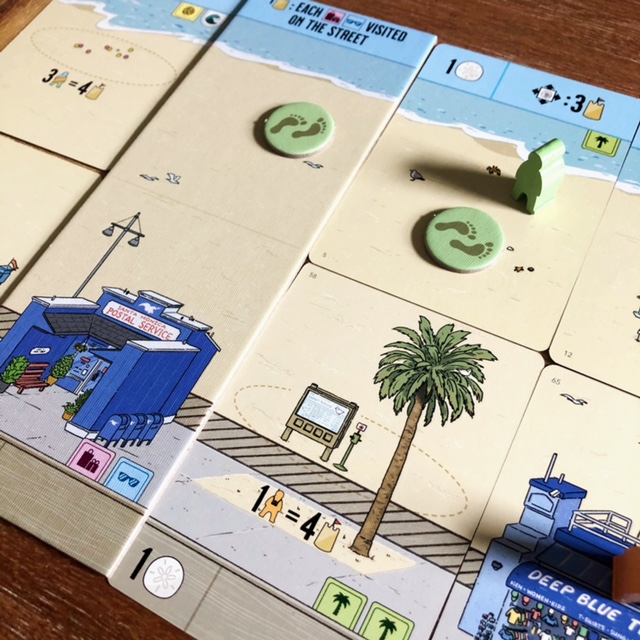
Light green VIP footprints (to mark the path of the VIPs for additional scoring)

Light orange tourists

Light green VIPs

With limited opportunities to move the people enjoying the beach and businesses of Santa Monica, you really need to consider placement.

Rule Book

The rule book is generally an easy read, but when we first started playing some of the descriptions of iconography and scoring methods were a bit confusing. We referred to the book quite a bit, and still do on occasion for clarification.

We are fans of “how to play” videos on You Tube, and use these for guidance with nearly every game we play.

How the Game Plays

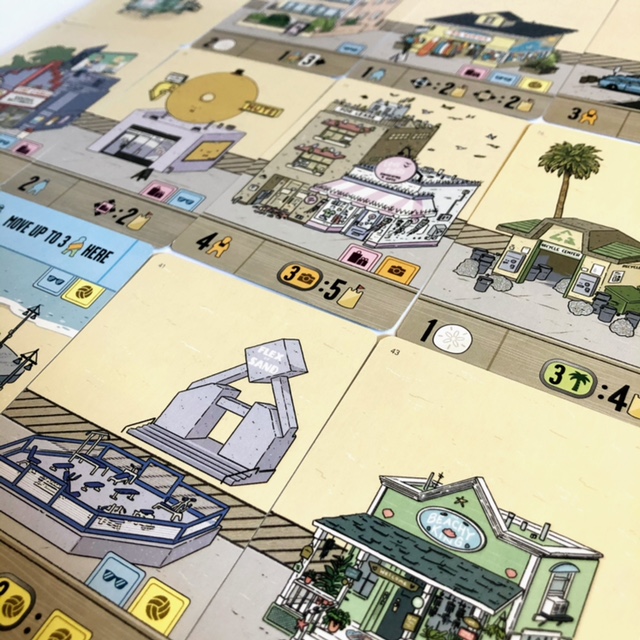
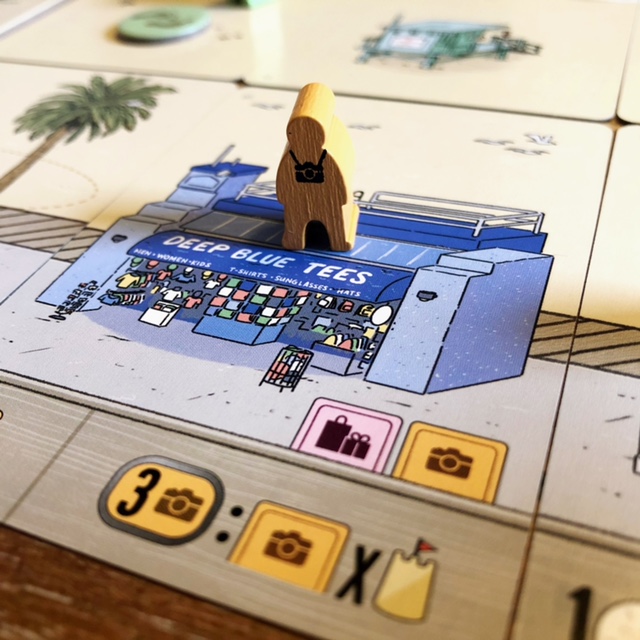
Players take turns drawing cards from the bottom row of eight face-up cards in the center of the table, playing them immediately into their neighborhoods. The bottom left side of the card displays what you take for playing the card (sand dollars, tourists, or locals) and the bottom right side of the card shows the scoring condition. The small rectangular icons above that show the features of the card, used towards scoring conditions. This could be adjacent property types or chains of multiple property types. (For the beach, this is all at the top of the card.)

Moving the meeples is the tricky part, so card placement is important! Players can pay sand dollars to take advantage of a purchased perk (shown on the large sand dollars) and move meeples, and some cards allow for movement. Why move the meeples? Some cards require them for scoring conditions like 3 playing volleyball at the beach.

You have 14 cards to score the most points as possible. Each game will also use one of the beach towel additional scoring conditions, so don’t forget to plan for those points too!

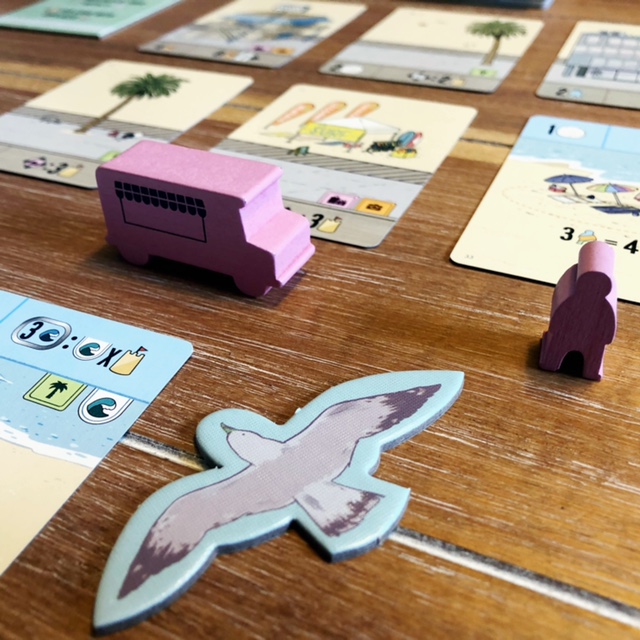
The Food Truck and the Foodie

If you choose the card above the food truck, you may take a sand dollar (used as currency in the game.)

If you choose the foodie, you may move one of your meeples.

If the food truck and foodie ever meet up, it’s a “happy day” and you get to take a couple of perks!

Also pictured: the sea gull first player marker.

Who Should Play?

People who like drafting and tableau building games with a nice theme we don’t usually see in boardgaming / people who like puzzley games

Good for newbies?

I think for new gamers, getting used to different scoring methods and iconography can be challenging. BUT, I think this game is GENERALLY accessible with a bit of patience.

Good for kids?

The Board Game Geek community puts this game at a 10+ (never go by the ages on the box, as this is for safety testing, NOT ability) and I would agree with that. There is minimal reading, but the game is strategic.

Click here to read our review of Santa Monica.

The Dice Tower Santa Monica Review with Tom Vasel
The video we watched to learn how to play Santa Monica.